


Luserna Stone in Piedmont: tradition and craftsmanship
Manavella is a family-run company based in Bagnolo Piemonte, in the province of Cuneo, which has been dedicated for generations to the extraction and processing of Luserna stone in Piedmont.
Experience, technical expertise and craftsmanship accompany every stage of production, from selecting the raw material to creating the finished product.
Working directly from its own quarries, the company maintains control over the entire production cycle and creates solutions for private clients, businesses and building professionals.
Manavella is a member of the “Consorzio Pietra di Luserna Coltivazione di Bagnolo Piemonte”, established to guarantee customers high product quality standards. The Consortium’s mark also serves as a reference point for promoting Luserna Stone, combining tradition and modernity in its creations.
A natural stone rooted in Piedmontese tradition
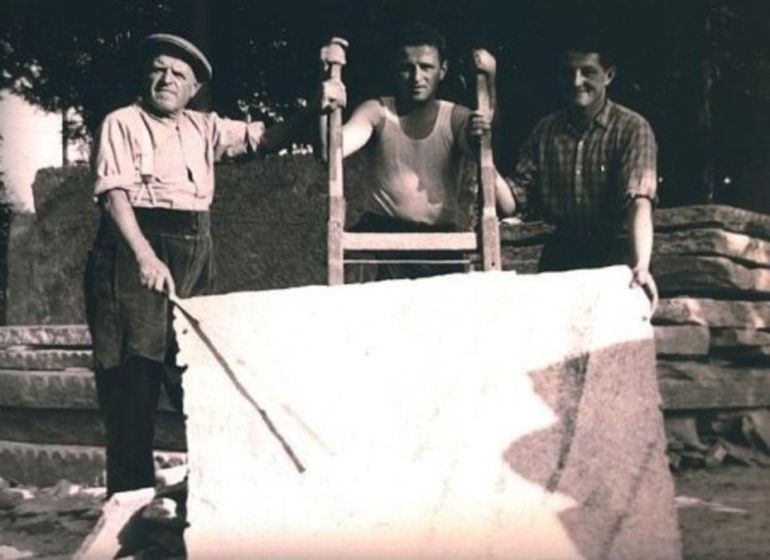
Luserna Stone is one of the outstanding materials of the Piedmont region and has been used since the 17th century for its strength, durability and versatility. Its natural, elegant appearance makes it suitable for a wide range of architectural applications, from private homes to public spaces.
Squares, roads, monuments and buildings in Italy and abroad demonstrate the value of this material. Thanks to its properties, Luserna stone in Piedmont is used to create paving, cladding and architectural elements, adapting to both traditional projects and contemporary solutions.
From quarry to finished product
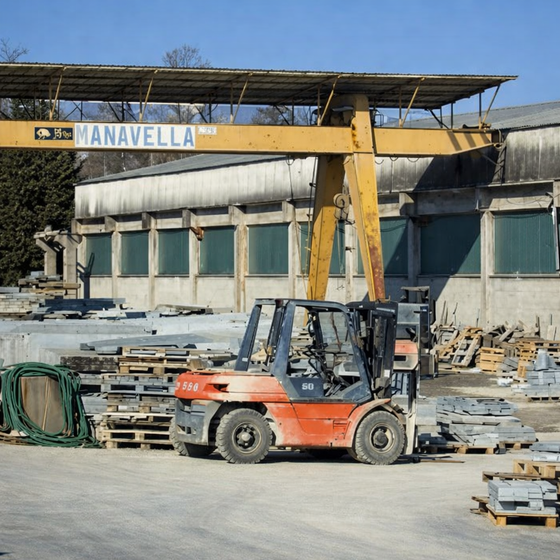
Managing its quarries directly enables Manavella to oversee every stage of production, bringing out the natural qualities of the raw material. Tradition, experience and attention to detail allow the company to offer reliable, bespoke finishes.
Choosing Luserna stone in Piedmont processed by Manavella means relying on a company deeply rooted in the local area, combining traditional stoneworking expertise with the demands of contemporary architecture and construction.
Characteristics of Luserna stone
Chemical composition (% by weight):
SiO2: 72.5 - 75.8
TiO2: 0.1 - 0.3
AlO3: 12.7 - 14.1
Fe2O3 0.4: - 1.1
FeO: 0.7 - 1.8
MhO: 0.1 - 0.9
CaO 0.2 - 1.0
Na2: 2.9 - 5.4
K2O: 2.2 - 4.7
P2O5: 0.1 - 0.2
p.c.* 0.5 - 1.6
*p.c.= loss on ignition
Physical and mechanical properties:
Apparent bulk density: 2620 - 2660 Kg./Mc.
Water absorption coefficient: 2.99 - 3.00 %
Simple compressive breaking load of test specimens in their natural state:
Apparent bulk density: 2620 - 2660 Kg./Mc.
Water absorption coefficient: 2.99 - 3.00 %
Simple compressive breaking load of test specimens subjected to freeze-thaw cycles:
With the load applied perpendicular to the foliation: 136 - 195 MPa
With the load applied parallel to the foliation: 84 - 113 MPa
Tangent modulus of elasticity: 60360 - 67330 MPa
Secant modulus of elasticity: 44650 - 48290 MPa
Direct tensile breaking load by bending: 19.1 - 23.7 MPa
Sliding abrasion wear:
Abrasion coefficient on the tribometer: 2.40 - 2.42 MPa Abrasion coefficient relative to S. Fidelino granite: 0.90
Impact breaking test:
Minimum drop height: 70 - 90 cm Linear thermal expansion coefficient: 0.0033 mm/m°C *1 MPa= 10.2 Kg./cmq
Lamellar gneiss
Lamellar gneiss is a type of metamorphic rock similar to granite, but rich in quartz and feldspars and low in ferromagnesian silicates. It forms at great depth in areas where tectonic plates have collided, corresponding to mountain ranges formed by these movements of the Earth's crust.
It is called lamellar because it appears divided into layers arranged one above the other like sheets of paper. Luserna stone is a type of lamellar gneiss quarried in Piedmont, in the Val Pellice and Valle Po quarries.


